


Integrating a child automation into a parent automation enhances reusability in your automation processes.
Overview
Integrating a child automation into a parent automation enhances reusability in your automation processes. This approach allows common logic to be defined once in a callable child automation and invoked from multiple parent automations.
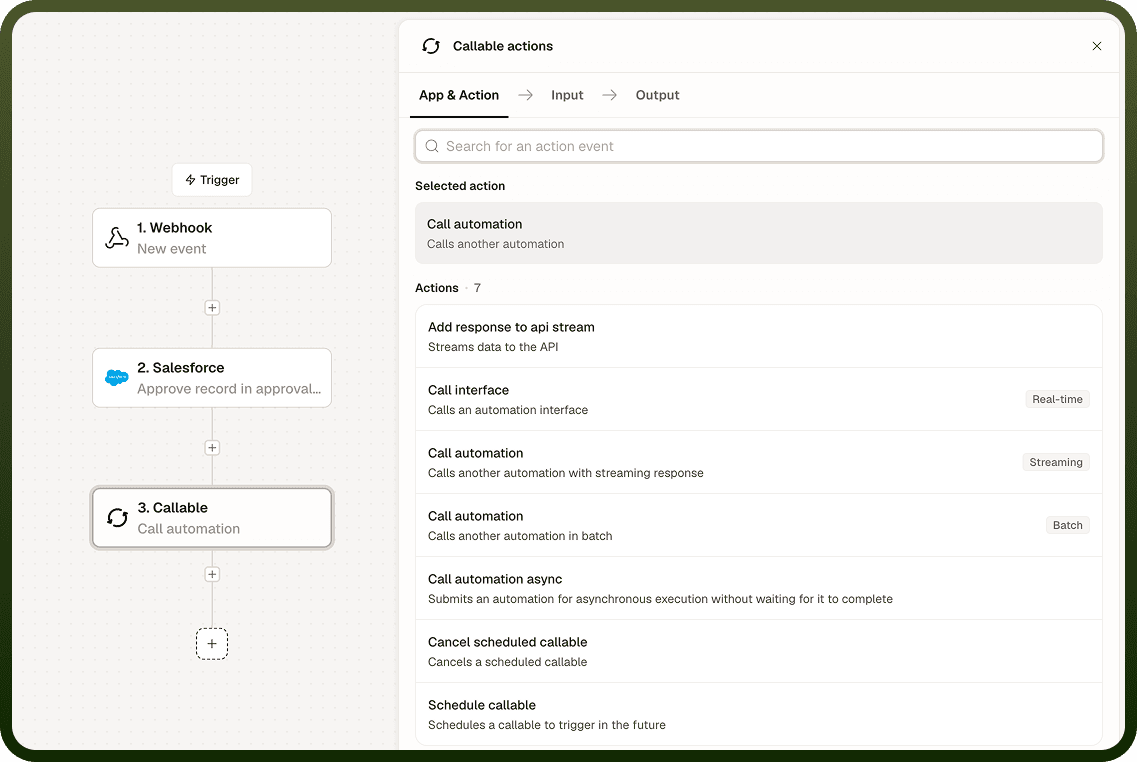
How to Call a Child Automation
Step 1: Insert Callable Action Node — Within the parent automation, select the "call another automation" action within the "callable" node.
Step 2: Select Child Automation — In the Callable node configuration settings, choose which child automation to execute. Only automations with "Call from another automation" as their trigger appear in the dropdown.
Step 3: Configure Execution Behavior — Determine how the parent automation proceeds after calling the child automation.
Wait for Completion
If True: The parent automation pauses until the child finishes. Use this when the parent depends on the child's output.
If False: The parent proceeds without waiting. Suitable for independent or parallel processes.
Step 4: Map Input Parameters — For every parameter outlined in the child automation's input schema, assign corresponding values from the parent automation. Values can be static data, outputs from earlier steps, or dynamic runtime values.
Step 5: Handle Child Automation Output — If the parent waits for the child to complete, you can use the child's output in subsequent parent steps. Map the output to variables or incorporate it into further actions.
Notes
Keep the following in mind when using Call Another Automation:
The child automation must have a Callable trigger and be deployed before it can be called from a parent automation.
Pass only the data the child automation needs; avoid passing the entire output of a previous step when a few fields are sufficient.
Child automation output is available as data pills in the parent after the call completes; confirm the child’s output schema before mapping it downstream.
If the child automation fails, configure the parent’s error handling behavior for that step; do not leave it at the default if the failure should stop the parent.
Changes to a child automation’s input schema require updating all parent automations that call it as well as any interface definitions it implements.